> For the complete documentation index, see [llms.txt](https://template.ishare.eu/llms.txt). Markdown versions of documentation pages are available by appending `.md` to page URLs; this page is available as [Markdown](https://template.ishare.eu/technical-building-blocks/data-value-creation-enablers/value-added-services.md).
# Value Creation Services
{% hint style="info" %}
This topic is not covered in the iSHARE Trust Framework. The data space is free to define agreements or remove this section.
{% endhint %}
Beyond simply sharing data, many data spaces benefit from services that help participants create additional value. According to the DSSC, value creation services are technical services that add functionality on top of data sharing. They can support individual participants, for example, through transformation or analytics, or create broader value by combining data from multiple sources.
Unlike core interoperability and trust services, these value-adding services are not defined in the iSHARE Trust Framework. They are not mandatory for every data space, but depending on the business model, use cases, or offerings, they may be important. Each data space is free to decide which services are relevant for its community and under what conditions they are provided.
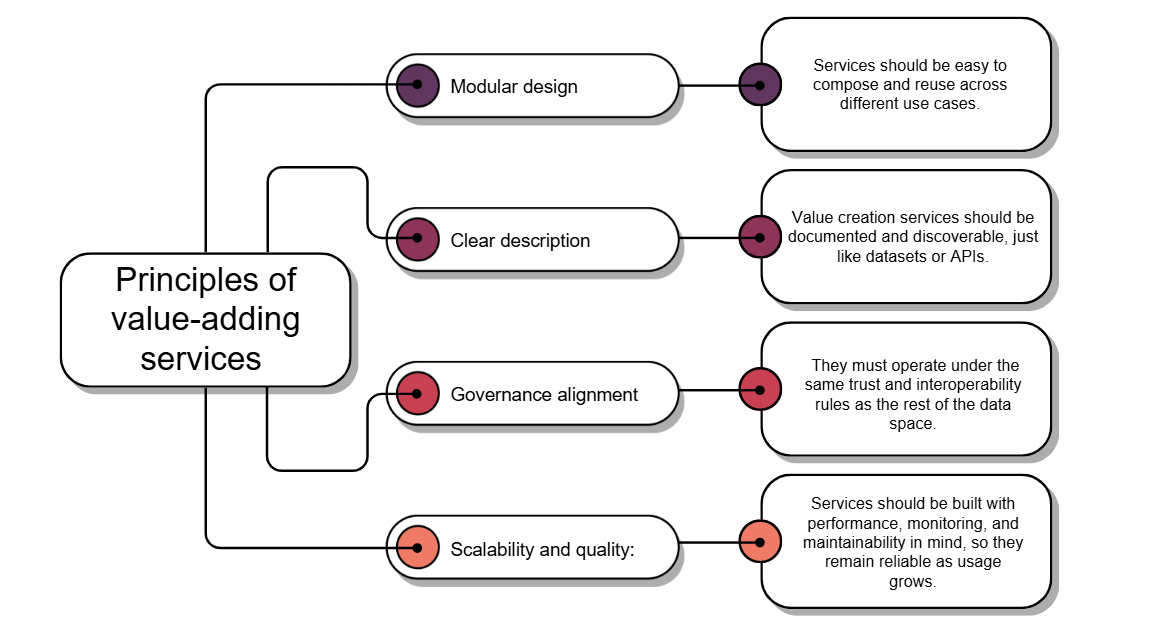
A few practical principles apply:
Figure 24. Principles of Value-Adding Services.
In line with DSSC, value creation services should also be described in a structured way so they can be published and discovered consistently, like other offerings. Standards such as [DCAT](https://www.w3.org/TR/vocab-dcat-3/) or [DCAT-AP](https://op.europa.eu/en/web/eu-vocabularies/dcat-ap) can help here, although further profiles or extensions may be needed depending on the type of service.
By introducing value creation services, data spaces can move from “data available” to “data usable and impactful,” helping participants unlock new applications and business opportunities. The business aspects of these services are considered in the [Data Space Offering](https://blueprint.dssc.eu/?pane=business\&technical=value-creation-services\&business=data-space-offerings) building block, while information about providers of such services is addressed in the [Intermediaries and Operators](https://blueprint.dssc.eu/?pane=business\&technical=publication-and-discovery\&business=intermediaries-and-operators) building block.
{% hint style="info" %}
See the complete DSSC Description [here](https://blueprint.dssc.eu/?pane=technical\&technical=value-creation-services).
{% endhint %}
{% hint style="info" %}
Value Creation Services connects closely with other building blocks:
* **Business Model:** Services add value and may generate revenue or costs.
* **Use Case Development:** Services provide key capabilities for use cases.
* **Data Space Offering:** Services enhance and extend data products.
* **Intermediaries and Operators:** Defines who provides which services.
* **Data, Services and Offerings Descriptions:** Provides metadata for service publication and discovery.
* **Provenance and Traceability:** Tracks service interactions with data.
* **Identity and Attestation Management:** Manages claims and attestations for services.
{% endhint %}
{% hint style="warning" %}
The guiding questions can help in the co-creation process and in defining this building block, so please see the next section.
{% endhint %}
---
# Agent Instructions
This documentation is published with GitBook. GitBook is the documentation platform designed so that both humans and AI agents can read, navigate, and reason over technical content effectively. Learn more at gitbook.com.
## Querying This Documentation
If you need additional information that is not directly available in this page, you can query the documentation dynamically by asking a question.
Perform an HTTP GET request on the current page URL with the `ask` query parameter, and the optional `goal` query parameter:
```
GET https://template.ishare.eu/technical-building-blocks/data-value-creation-enablers/value-added-services.md?ask=&goal=
```
`ask` is the immediate question: it should be specific, self-contained, and written in natural language.
`goal` is optional and describes the broader end goal you are ultimately trying to accomplish on behalf of the user. GitBook uses it to tailor the answer towards what is most useful for that goal.
The response will contain a direct answer to the question and relevant excerpts and sources from the documentation.
Use this mechanism when the answer is not explicitly present in the current page, you need clarification or additional context, or you want to retrieve related documentation sections.